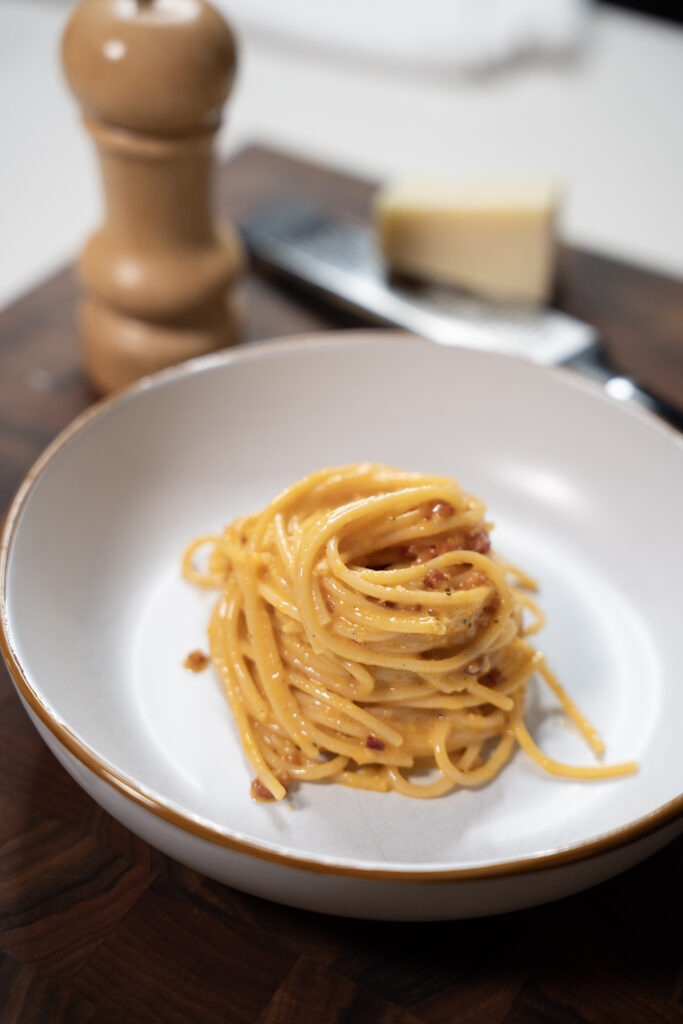
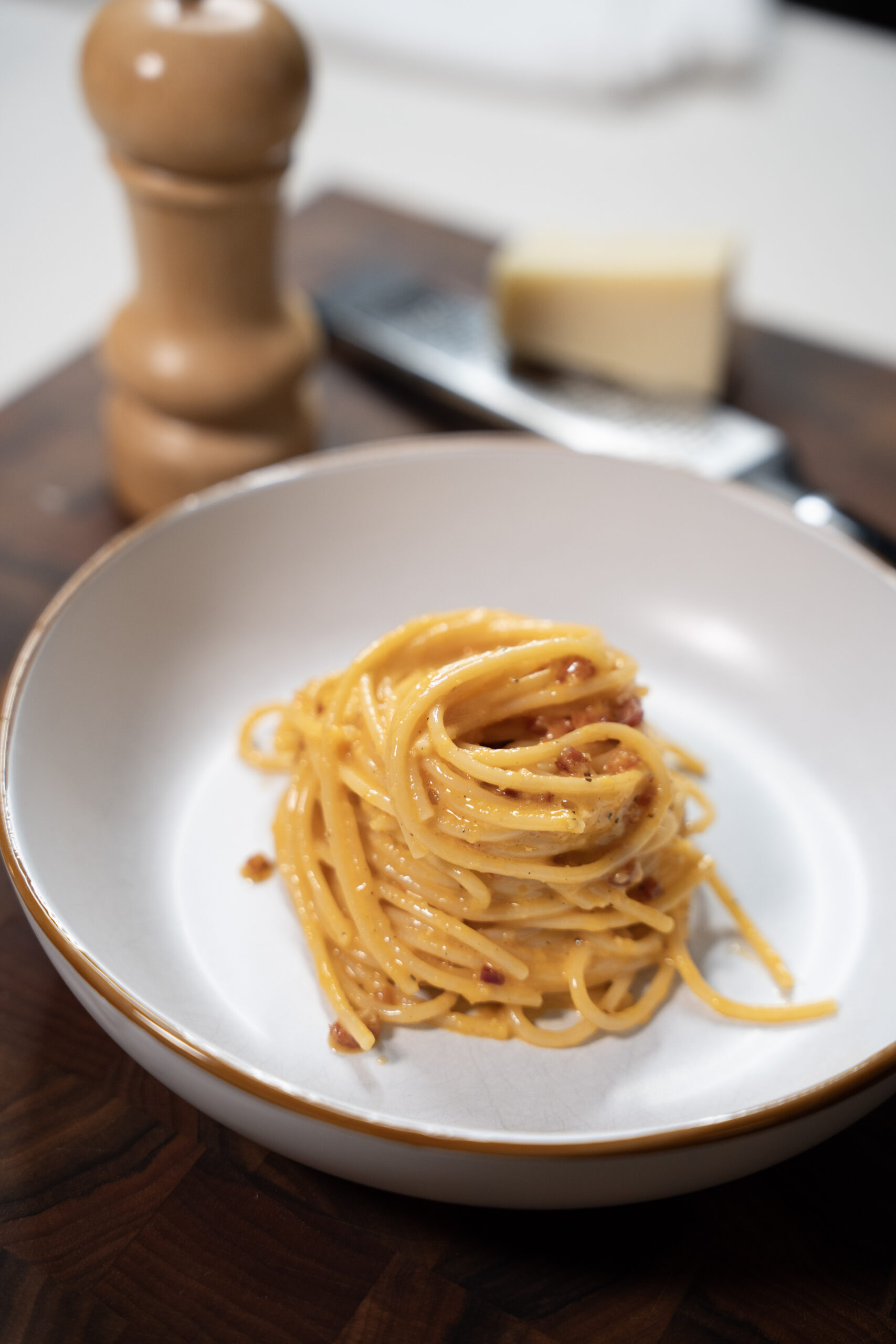
Let’s talk about carbonara, the pasta dish that has somehow convinced an entire generation of home cooks that it’s dangerous. That it requires a culinary degree, a Roman grandmother standing over your shoulder, and exactly the right cured pork product or the whole thing falls apart.
It doesn’t. I promise.
Carbonara is a weeknight pasta. It takes about 30 minutes, uses five real ingredients, and costs less than whatever sad desk lunch you had today. The reason it has a reputation for being “hard” comes down to one thing: eggs. Specifically, the fear of scrambling them. I’ll get to that. But first, can we talk about the pork situation?
Guanciale, Pancetta, Bacon — Pick Your Fighter
Traditionally, carbonara is made with guanciale, a cured pork cheek that is fatty, rich, deeply porky, and absolutely delicious. It’s also nearly impossible to find at a regular American grocery store, which is probably why you’ve never made carbonara at home. And honestly? That’s a little ridiculous.
Here’s my hierarchy: guanciale if you can find it, pancetta if you can’t (which is most of the time, and it’s great), and thick-cut bacon if that’s what’s in your fridge. Yes, bacon. Bacon carbonara is not a crime. It brings a little smokiness to the party that purists will clutch their pearls over, and the rest of us will absolutely enjoy. Use what you’ve got. Move on. And if anyone gives you grief about using bacon, just tell them you’re doing a “rustic American interpretation.” Works every time.
The Egg Thing — Let’s Demystify It
Here’s why people scramble their eggs: they add them to a pan that’s too hot. That’s it. That’s the whole mystery. You’ve been scared of carbonara this whole time because of a temperature problem. Let that sink in.
The move is simple. Render your pork, pull the pan off the heat, let it cool for 30 to 60 seconds, add a splash of starchy pasta water, and then add your egg and cheese mixture. The residual heat does the work. You toss it fast, you add a little more pasta water if things tighten up, and in under a minute you’ve got a glossy, silky, restaurant-worthy sauce. No cream needed. No corners cut. Just eggs, cheese, fat, and starchy water doing exactly what they’re supposed to do.
The other key? I only use egg yolks here, no whites. Yolks are richer, fattier, and they make a sauce that coats every strand of spaghetti like it has something to prove. What do you do with the leftover whites? Make meringue. Or just feel guilty about them in the fridge for four days like the rest of us.
Two Cheeses, One Good Reason
Classic carbonara is pecorino romano only. I use both pecorino and parmigiano reggiano, and I’m not sorry about it. Pecorino brings the salt and the funk, that sharp, briny, slightly sheepy bite that makes carbonara taste like carbonara. But parmigiano adds a quiet depth, a nuttiness that rounds everything out. Think of pecorino as the lead vocalist and parmigiano as the bassist. You might not always notice the bass, but you’d absolutely miss it if it wasn’t there. (Shoutout to bassists everywhere. You are seen.)
The ratio is 60/40 pecorino to parm. Grate it yourself. Fine as you can get it, microplane if you have one. Pre-grated cheese from a bag will make your sauce grainy and your Italian ancestors disappointed.
The Bottom Line
Carbonara is not precious. It’s not scary. It’s five ingredients, one pan, one pot, and thirty minutes standing between you and one of the best pasta dishes on the planet. Make it on a Tuesday. Make it for two, or scale it up for eight since the ratios are dead simple. Just don’t add cream, don’t scramble the eggs, and don’t let anyone tell you that bacon doesn’t belong here.
It does. Everything is going to be fine. And if it isn’t, well… at least you didn’t add cream.
2
servings10
minutes20
minutes30
minutesIngredients
6 oz dry spaghetti
4 egg yolks
1.2 oz pecorino romano, finely grated
0.8 oz parmigiano reggiano, finely grated
3 oz pancetta (or guanciale, or thick-cut bacon), diced
½ tsp coarse black pepper, freshly ground
1 tbsp kosher salt (for pasta water)
Directions
- Whisk together the egg yolks, pecorino, parmigiano, and black pepper in a medium bowl until you have a thick, gritty paste — that's exactly right. Set aside at room temp. (Room temp eggs emulsify WAY better than cold ones.)
- Bring a large pot of water to a boil. Add the salt. The water should taste pleasantly salty — carbonara gets no extra salt at the end, so this is your only chance.
- Add the pancetta to a cold skillet, then bring to medium-low heat. Render slowly until golden and just starting to crisp, about 6–8 minutes. Remove the meat with a slotted spoon and set aside. Leave every drop of fat in the pan.
- Drop the spaghetti into the boiling water and cook until just shy of al dente — it'll finish in the pan. Before draining, scoop out at least 1 cup of pasta water and set aside.
- Transfer the pasta directly into the skillet with the rendered fat using tongs — no need to fully drain. Take the skillet OFF the heat and let it cool for 30–60 seconds. Add a splash of pasta water (2–3 tbsp) and toss to coat.
- Pour the egg and cheese mixture over the pasta. Toss constantly and quickly — swirly, mopping motions. Add pasta water a splash at a time if things tighten up too fast. You're looking for glossy and saucy, not sticky or dry.
- Fold in the crispy pancetta. Portion immediately into warm bowls. Top with another crack of black pepper, a shower of extra pecorino, and any remaining crispy bits from the pan. Eat immediately.
Notes
- Pork hierarchy: Guanciale (traditional, rich, porky) → Pancetta (easy to find, cleaner flavor) → Thick-cut bacon (slight smokiness, totally fine, don't let anyone shame you).
- The cardinal sin: Adding the egg mixture to a screaming hot pan. Off heat, let it cool slightly, THEN add the eggs. Patience here = silky sauce.
- Cheese tip: Grate it yourself and grate it fine — microplane fine if you have one. Pre-grated cheese won't melt the same way and can make the sauce grainy.
- Scaling: 2 yolks / 1 oz cheese / 1.5 oz pasta / 1.5 oz pork per person. Scales up cleanly to any crowd.

