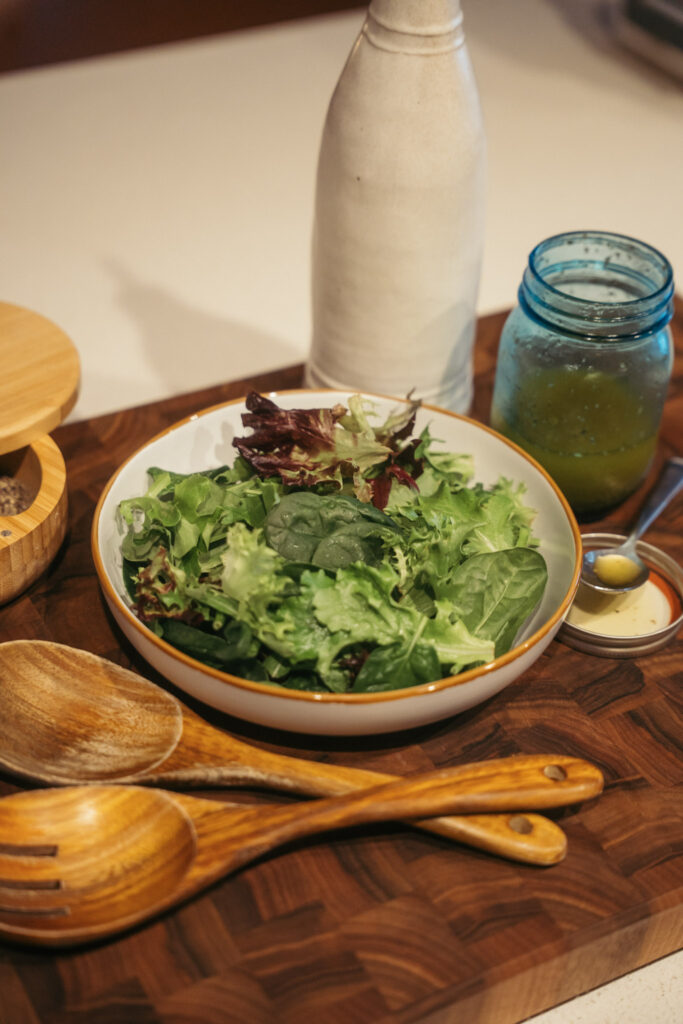
The Noble Side Salad Deserves Better. Here’s How to Dress It.

Here’s how most of my weeknight meal planning goes: protein, sorted. Carb, obviously sorted, and sorted first if I’m being honest. And then I look at the plate and think, I probably need something green on here. Not because I want to. Because: health. It matters. Allegedly.

So salad becomes the answer. And honestly? It’s a good answer. It’s fast, it’s easy, it goes with basically everything, and if you do the dressing right, it actually tastes like something you chose to eat rather than something you ate out of obligation.

Now, I have to confess something. And I need you to hear me out before you judge me.

I could live off the endless salad and breadsticks at Olive Garden. I know. I KNOW. I am not speaking to the quality of the pasta, which is a separate conversation for a separate day. I am speaking exclusively about the salad and the breadsticks, which I have chosen to call the edible totems of self love, because that is what they are to me.

But here’s the thing I eventually figured out: that Olive Garden salad dressing? The one that feels like it came from some sacred Italian grandmother’s secret vault? It’s basically just pantry stuff. Vinegar, oil, seasoning, a little mustard, some herbs. That’s it. Which brings me to the whole point of this post.

Salad dressing is not complicated. It just has a reputation for being complicated. And I want to dismantle that reputation, one increasingly lazy recipe at a time.

A Brief History That I Looked Up And Found Genuinely Interesting

So I went down a little rabbit hole while putting this together, and it turns out the word “salad” itself comes from the Latin salata, which means “salted things.” Romans were literally just salting their greens and eating them. That was the whole dish. That was dinner.

Which means the most ancient, historically authentic way to dress a salad is also the simplest: just salt, olive oil, and a splash of vinegar. The elaborate stuff came later. Humans made it complicated, as humans tend to do.

I find this deeply vindicating. We are not going from correct to lazy in this post. We are going from modern to ancient. You’re welcome.

Three Dressings, Decreasing Effort, All Actually Delicious

I’ve put together three recipes here, and they go in order from most involved to genuinely almost not a recipe at all. Think of it as a choose-your-own-adventure, where all adventures end in salad.

Simple: Traditional Italian Dressing

This is your entry-level from-scratch dressing, and yes, it takes a few more ingredients than the other two. But it’s still just a jar and a shake. The emulsification happens because a little Dijon acts as a binder between the oil and the acid, which sounds science-y, but really just means “this is why it doesn’t immediately separate into sad oil puddles.”

The oregano is doing the heavy lifting here. You can use dried, and it’s completely fine. This is a weeknight dressing, not a cooking competition.

Make a batch on Sunday, keep it in the fridge all week, shake before using. That’s the move.

Simpler: Basic Vinaigrette

Strip the Italian dressing down to its skeleton and you get a vinaigrette. Three-to-one ratio: three parts oil to one part acid. A little Dijon to hold it together. Salt and pepper. Done.

The ratio is the thing to remember here, because once you know it, you can make a dressing out of basically any oil and any acid you have on hand. Red wine vinegar, white wine vinegar, lemon juice, balsamic, all viable. Olive oil, avocado oil, even a neutral vegetable oil if that’s what you’ve got.

This is the dressing that makes you feel like you have your life together. It takes about 90 seconds. I am not exaggerating.

Simplest: The Traditional Table Salad

And here we arrive at the ancient Roman approach. No blending, no shaking, no ratios to remember. You season the lettuce directly, salt and pepper right on the leaves, drizzle olive oil over the top, then a splash of red wine vinegar, and finish with shaved or grated parmesan.

This sounds too simple to be worth making. It is not. The salt pulls just enough moisture from the leaves to help everything cling. The oil coats. The vinegar brightens. The parmesan makes you feel fancy without doing anything fancy.

This is the salad I make when I have zero bandwidth left in my brain. Which, on a Tuesday night after I’ve already made the protein and the carb, is most of the time.

The Takeaway

Salad dressing exists on a spectrum, and every point on that spectrum is valid. Some nights you have time and energy for the full Italian. Some nights you have 90 seconds and a jar. Some nights you are basically just throwing things at lettuce and hoping for the best.

All three of those nights end in salad. And all three of those salads are better than anything out of a bottle. Yes, including Olive Garden. I said what I said.

Recipes are below. Start wherever feels right.

Italian Salad Dressing

Recipe by Jarrad HowardCourse: SaladsCuisine: ItalianDifficulty: Easy
Servings

8

servings
Prep time

5

minutes
Total time

5

minutes

Bold, herby, and just a little punchy, this is the dressing that makes a simple bowl of greens feel like it has somewhere to be. It pairs especially well with romaine, iceberg, or a crisp chopped salad, but honestly any leafy greens will work beautifully here.

Ingredients

  • 1/2 cup extra virgin olive oil

  • 1/2 cup canola oil

  • 1/4 cup red wine vinegar

  • 1/2 tsp Dijon mustard

  • 2 cloves garlic, minced*

  • 1/2 tsp salt

  • 1/4 tsp black pepper

  • 2 tsp dried oregano

  • 1 tsp sugar (optional)

Directions

  • Add all ingredients to a jar with a tight-fitting lid.
  • Seal the lid and shake vigorously for about 30 seconds until well combined.
  • Taste and adjust salt, pepper, or vinegar as needed.
  • Store in the refrigerator for up to 1 week. Shake well before each use.

Notes

  • *A Note on Garlic: If you prefer a more subtle garlic flavor, simply smash the cloves with the flat of a knife and add them whole to the jar. They will give the dressing a gentle garlic essence without the intensity of minced. Remove before serving, or just leave them in. Your call.

Basic Vinaigrette

Recipe by Jarrad HowardCourse: SaladsDifficulty: Easy
Servings

4

servings
Prep time

5

minutes
Total time

5

minutes

Clean, bright, and endlessly flexible, a good vinaigrette is the little black dress of salad dressings. It shines on peppery arugula, delicate butter lettuce, or a simple mixed green salad, but any leafy greens you have on hand will be happy to wear it.

Ingredients

  • 3 tbsp extra virgin olive oil

  • 1 tbsp vinegar (red wine, white wine, apple cider, balsamic... choose your fighter!)

  • 1 to 1.5 tbsp fresh lemon juice (about half a lemon)

  • 1 tsp Dijon mustard

  • 2 cloves garlic, minced*

  • Salt and pepper to taste

Directions

  • Add all ingredients to a jar with a tight-fitting lid.
  • Seal the lid and shake vigorously for about 20 to 30 seconds until well combined.
  • Taste and adjust salt, pepper, or acid as needed.
  • Use immediately or store in the refrigerator for up to 5 days. Shake well before each use.

Notes

  • *Garlic note: Not looking for a full garlic punch? Smash the cloves and toss them in whole instead. You will still get that warm, garlicky background flavor without it taking over. Fish them out before serving or leave them in for the next pour.

Basic Oil & Vinegar Dressing

Recipe by Jarrad HowardCourse: SaladsDifficulty: Easy
Servings

4

servings
Prep time

2

minutes
Total time

2

minutes

This is salad at its most honest. Just good olive oil, a splash of acid, and greens that finally get to be the star. Add to any leafy greens you have on hand. My personal favorite is peppery arugula, but any green will do just fine! Top it with Parmesan and call it done.

Ingredients

  • 3 tbsp extra virgin olive oil

  • 1 tbsp red wine vinegar (or lemon juice)

  • Salt and pepper to taste

  • Parmesan, shaved or grated, to finish

Directions

  • Place your greens in a large bowl and season directly with salt and pepper. Toss lightly.
  • Drizzle the olive oil over the greens and toss to coat.
  • Add the red wine vinegar and toss again. Taste and adjust salt or acid as needed.
  • Finish with Parmesan and serve immediately.

Save Room for More

Roasted Red Pepper Bisque with Shaved Asiago & Crispy Garlic Panko
Spring Vegetable Frittata: Fun to Say, Easy to Make
Crispy Chicken Cutlets (The Weeknight Hero You Didn’t Know You Needed)